
Eclipse cycle
Intervals after which eclipses repeat under similar conditions.

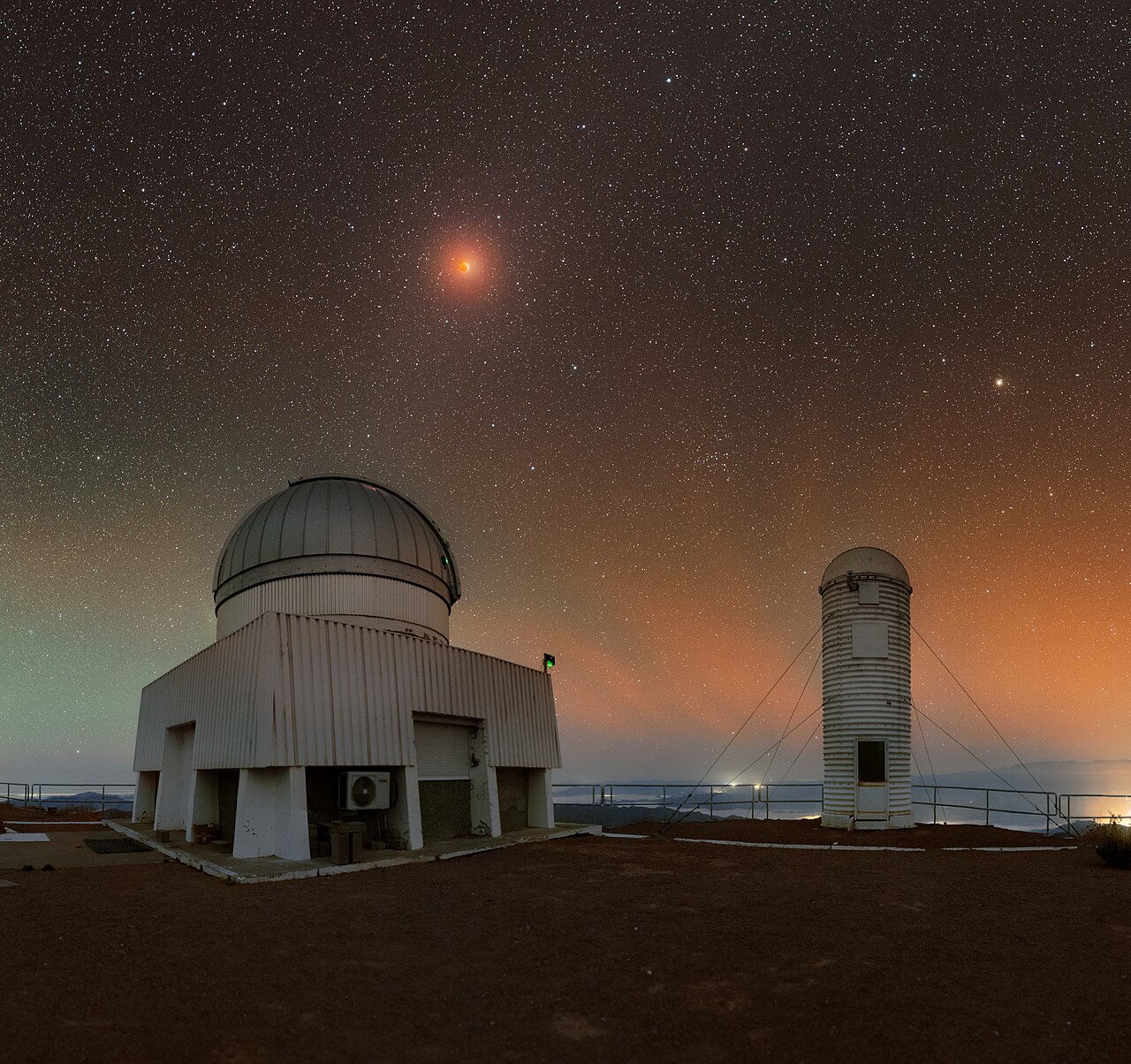
CTIO/NOIRLab/NSF/AURA/P. Horálek (Institute of Physics in Opava) · CC BY 4.0
An eclipse cycle is an interval of time after which a series of eclipses repeats, with the Sun, Earth, and Moon returning to nearly the same relative geometry. These cycles allow the prediction of future eclipses based on past occurrences, and the series of eclipses separated by such an interval is called an eclipse series.
- key_periods
- synodic month, draconic month, anomalistic month
- eclipse_season_frequency
- twice per year, lasting one or two months
- average_frequency_of_total_solar_eclipse
- every 18 months somewhere on Earth
Lore & Background
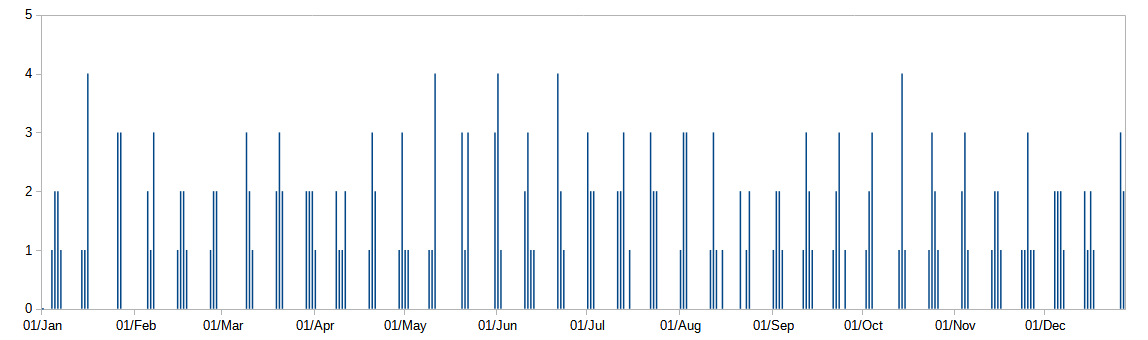
Eclipses occur when the Moon is near a node of its orbit at syzygy (new or full moon). Because the Moon's orbit is tilted about 5°9′ relative to the ecliptic, most new and full moons do not produce eclipses. An eclipse can only happen when the Moon's ecliptic latitude is low, which occurs when the Moon is near one of its orbital nodes, and the Sun must also be near a node at that time. Up to three eclipses may occur during an eclipse season, which happens twice a year when the Sun is near the nodes. The difference between the synodic month (29.53 days) and the draconic month (27.21 days) is about 2⅓ days, so after one month the geometry shifts and eclipses cease until about five or six lunations later, when the new moon falls near the opposite node. During a saros series, the parameter gamma (how far north or south the Moon passes relative to the ecliptic) changes monotonically, with larger changes when Earth is near aphelion (June–July) and smaller changes near perihelion (December–January).
Reader's Guide
Eclipse cycles are fundamental to understanding the recurrence of solar and lunar eclipses. The saros cycle, lasting about 18 years 11 days and 8 hours, allows a given eclipse to be repeated with nearly identical geometry, though not in the same geographical region. A specific geographical region sees a particular solar eclipse every 54 years 34 days. The periodicity of solar eclipses in succession is either 1, 5, or 6 synodic months. These cycles depend on the near-integer matching of three lunar orbital periods: the synodic month (phases), the draconic month (node passage), and the anomalistic month (distance from Earth). The Moon's elliptical orbit causes its apparent diameter to vary by about 6%, affecting eclipse type and duration. The conditions for repetition include the Moon being at the same node and same distance from Earth, with Earth at nearly the same distance from the Sun and same tilt.
Did You Know?
- The difference between the synodic month and the draconic month is nearly 2⅓ days.
- The Moon's orbital nodes precess westward, completing a full circle in about 18.60 years.
- A particular solar eclipse repeats after approximately 18 years 11 days and 8 hours, known as the saros.
- The apparent angular diameter of the Moon varies by about 6% due to its elliptical orbit.
The Mechanics and Classification of Lunar Eclipses
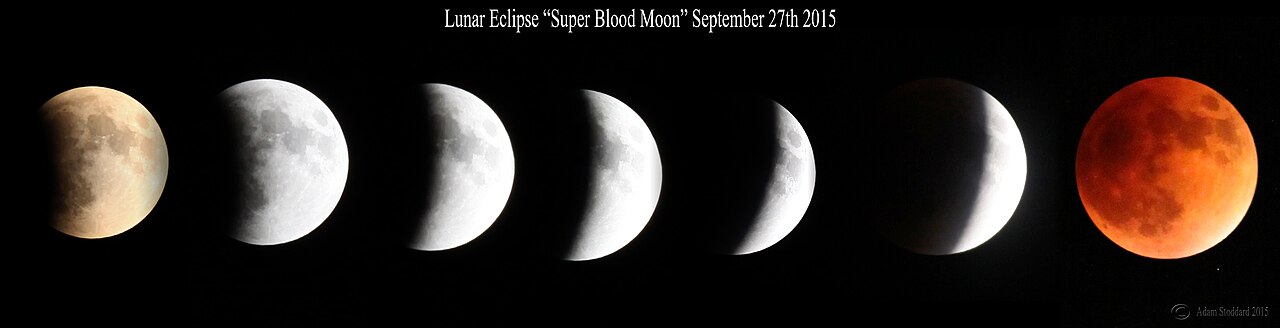
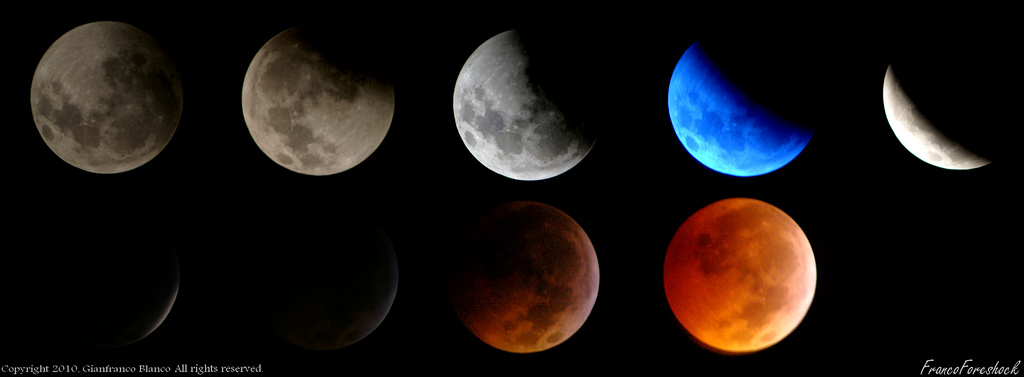
A lunar eclipse unfolds when the Moon drifts into Earth's shadow, an alignment that only becomes possible during eclipse season, when the Moon's orbital plane lines up closely enough with the Earth-Sun axis. The specific character and length of any given event hinge on how near the Moon passes to the lunar node. Astronomers sort these events into several categories. A penumbral eclipse happens when Earth's silhouette only partially obscures the Sun from the Moon's perspective, leaving some direct sunlight still reaching the lunar surface; from Earth this reads as a gentle dimming. Roughly one-third of all lunar eclipses fall into this class, and only about three percent of those achieve the rarer status of a total penumbral eclipse, where the Moon sits wholly within the penumbra. A partial eclipse occurs when the Moon dips partly into the darker umbra, producing a sharply defined shadowed region. When the entire near side of the Moon enters the umbra, the event is total. If the Moon additionally threads through the very center of the shadow, contacting the antisolar point, it earns the label of a central lunar eclipse—a configuration that accounts for nearly sixty percent of all total eclipses.
The Red Glow: Physics Behind the Blood Moon
The signature coppery hue of a total lunar eclipse is a direct consequence of how Earth's atmosphere filters sunlight. As the Moon slides into the umbra, the only rays that can still reach its surface must thread through a long, dense column of air. During this passage, Rayleigh scattering preferentially strips away the shorter wavelengths—violet, blue, green—while the longer red and orange wavelengths survive the journey and reflect off the lunar regolith back toward our eyes. The effect is essentially the same physics that paints our sky at sunrise and sunset. A helpful mental model: from the Moon's vantage, the Sun would appear to be setting or rising directly behind Earth. The Moon never goes fully pitch-black because refraction bends some sunlight into the shadow cone; without an atmosphere, totality would mean complete darkness. The exact shade of red varies from eclipse to eclipse depending on how much dust and cloud material is suspended in the air. A dustier atmosphere scatters more of the remaining non-red light, pushing the color toward a deeper, richer crimson. Major volcanic eruptions, which inject vast quantities of particulate matter into the stratosphere, can dramatically intensify this effect for any eclipse that follows.
Duration, Distance, and the Geometry of Time
Unlike solar eclipses, which are fleeting and visible only from a narrow track, a lunar eclipse is a broad, patient spectacle. Any observer on the night side of the planet can watch it unfold, and the event typically stretches well past an hour. No special eye protection is needed, making it one of the most accessible astronomical displays. The Moon cruises along its orbit at roughly 1.03 kilometers per second—just over its own diameter per hour—which sets a practical ceiling on how long totality can last, at approximately 107 minutes. However, the full sequence from the first contact of the Moon's limb with Earth's shadow to the final contact can extend to as much as 236 minutes. The Moon's distance from Earth also plays a role. Near apogee, the farthest point in its elliptical orbit, the Moon moves at its slowest. Because the diameter of Earth's umbra does not shrink noticeably over the range of the Moon's orbital distance, a slower-moving Moon simply spends more time inside the shadow, stretching the duration of totality. This interplay of orbital speed and shadow geometry means that two total eclipses can differ significantly in how long the deep red phase endures.
Limb Brightness and the Selenelion: The Observer's Vantage
One of the most visually striking transitions during a total lunar eclipse involves the Moon's limb, its curved edge. Just before the disk is fully engulfed, the sliver of limb still struck by direct sunlight glows far brighter than the rest of the surface. This occurs because the Moon's cratered, irregular terrain at the limb reflects sunlight back toward the observer in greater quantities than the flatter central regions do. The effect is analogous to velvet draped over a rounded form, where the center of the curve appears darkest. Any airless, heavily cratered body viewed opposite its Sun—Mercury, for instance—would display the same limb-brightening. Once totality is reached, the surface evens out to a more uniform glow, and stars become visible around the disk. A related phenomenon is the selenelion, or horizontal eclipse, in which both the Sun and the eclipsed Moon are visible simultaneously, each hovering just above an opposite horizon. This can only occur at the very edge of sunset or sunrise, and it is experienced during every total lunar eclipse. It is not a separate celestial event but rather a unique perspective available to observers on high ridges at that precise moment.
Gallery

Frequently Asked Questions
What exactly is an eclipse cycle in celestial mechanics?
An eclipse cycle is the time interval after which the Sun, Earth, and Moon line up in nearly the same relative geometry, causing a similar series of eclipses to repeat. It works because the synodic, draconic, and anomalistic months all realign after a fixed period, letting astronomers project future events from past ones.
How often do eclipse seasons actually happen each year?
Eclipse seasons pop up twice a year, each lasting anywhere from one to two months, whenever the Moon's nodes cross close to the Sun–Earth line. You simply cannot get an eclipse outside one of those windows, no matter how the calendars line up.
If I live on Earth, how often should I expect a total solar eclipse to happen *somewhere* on the planet?
On average a total solar eclipse sweeps across some patch of Earth roughly every 18 months, though any single city will wait centuries between visits. The 18-month figure is a global average, not a local one, so don't plan your vacation around it.
More in Orbits And Celestial Mechanics 1-24
Elsewhere in the Orbits And Celestial Mechanics universe
Spotted an error? Know more?
This is a living reference — every entry is fact-audited, and reader corrections feed straight into our audit queue. Suggest an edit · See this site's audit record