
Equatorial coordinate system
A geocentric system for locating celestial objects.

Anskar · CC BY-SA 3.0
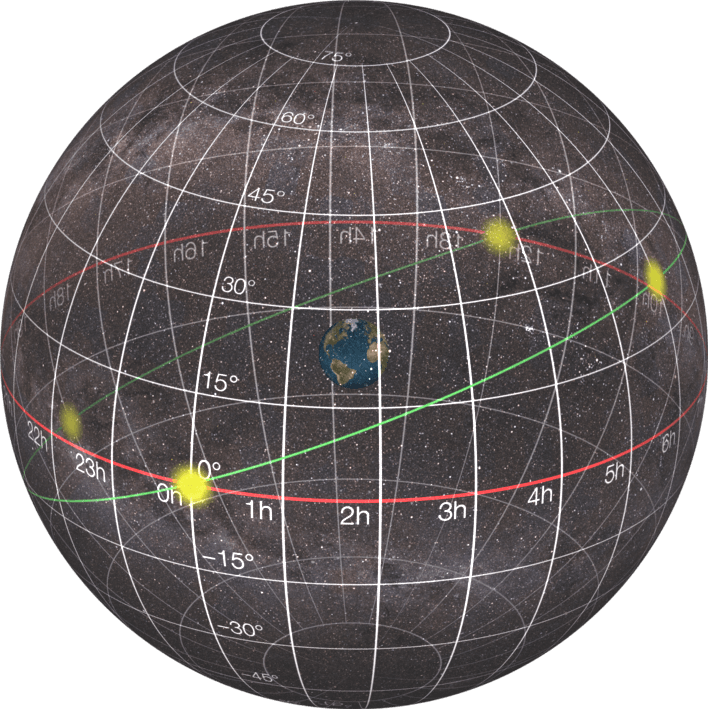
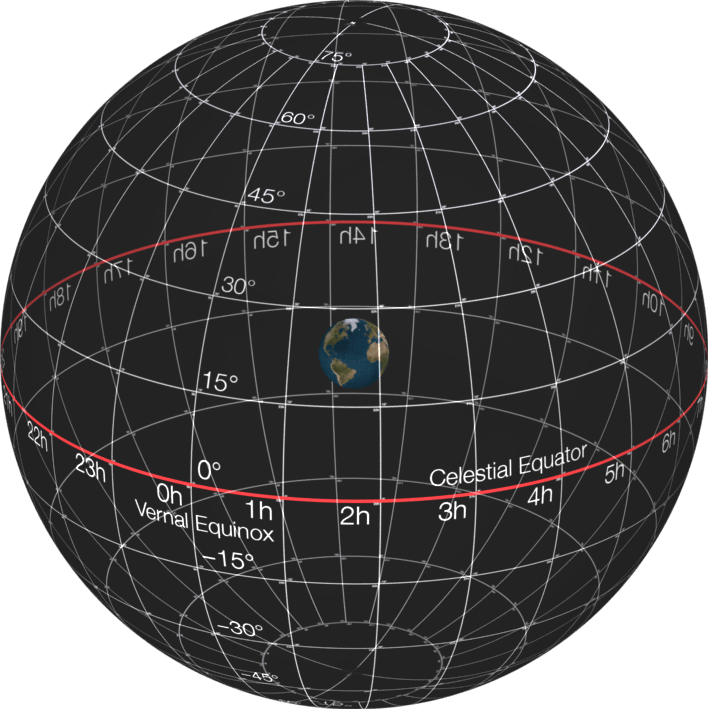
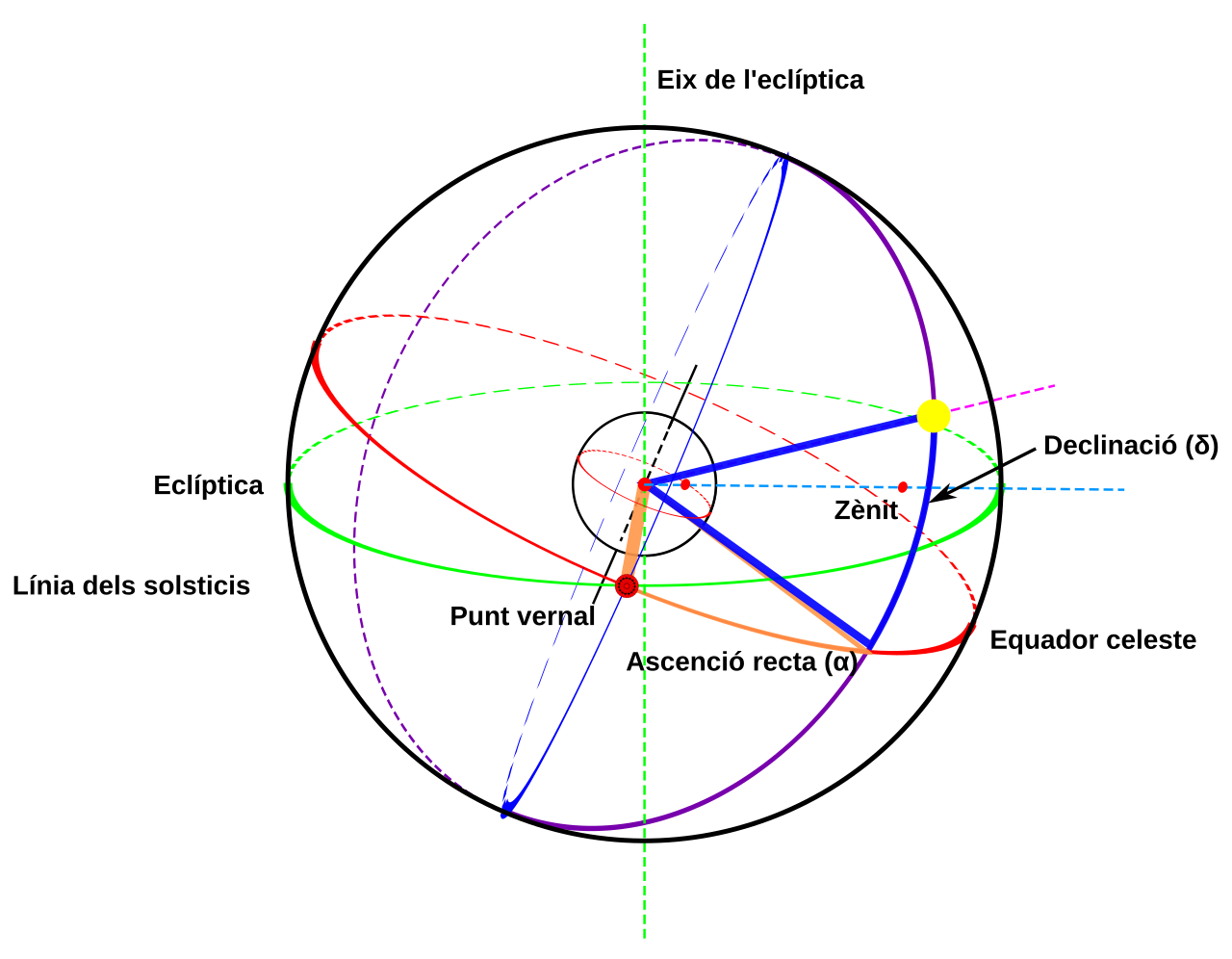
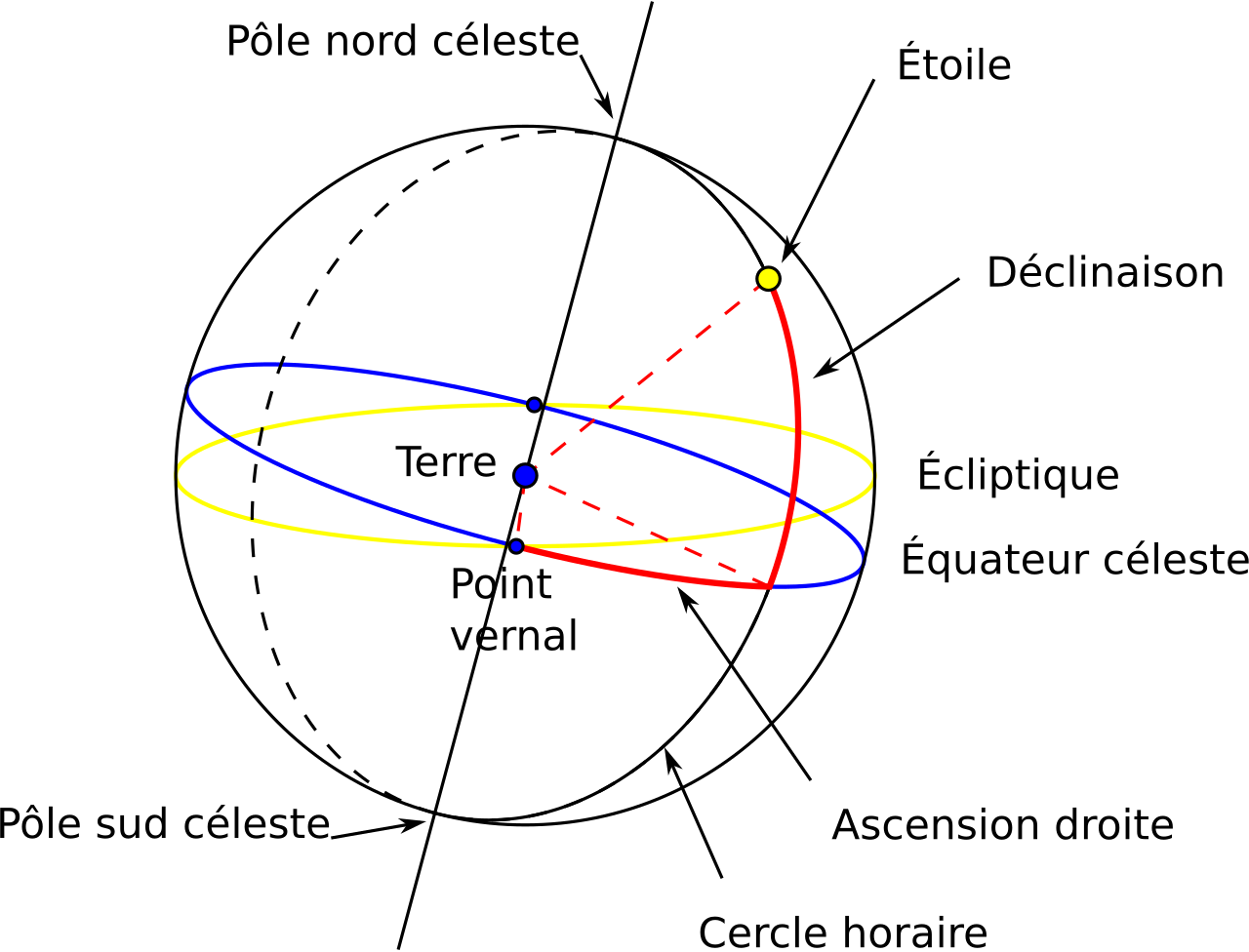
The equatorial coordinate system is a celestial coordinate system widely used to specify the positions of celestial objects. It may be implemented in spherical or rectangular coordinates, both defined by an origin at the centre of Earth, a fundamental plane consisting of the projection of Earth's equator onto the celestial sphere (forming the celestial equator), a primary direction towards the March equinox, and a right-handed convention.
- type
- Coordinate system
- field
- Astronomy, astrodynamics
- origin
- Geocentric (centre of Earth)
- fundamental_plane
- Celestial equator
- primary_direction
- March equinox
- convention
- Right-handed
Lore & Background
The equatorial coordinate system is geocentric, meaning coordinates are as seen from the centre of Earth as if it were transparent. The fundamental plane and primary direction mean the system, while aligned with Earth's equator and pole, does not rotate with the Earth, but remains relatively fixed against the background stars. A right-handed convention means coordinates increase northward from and eastward around the fundamental plane. Superimposed on this is a smaller motion of the ecliptic, and a small oscillation of the Earth's axis, nutation. In order to fix the exact primary direction, these motions necessitate the specification of the equinox of a particular date, known as an epoch, when giving a position. The three most commonly used are mean equinox of a standard epoch (usually J2000.0, but may include B1950.0, B1900.0, etc.), mean equinox of date, and true equinox of date.
Reader's Guide
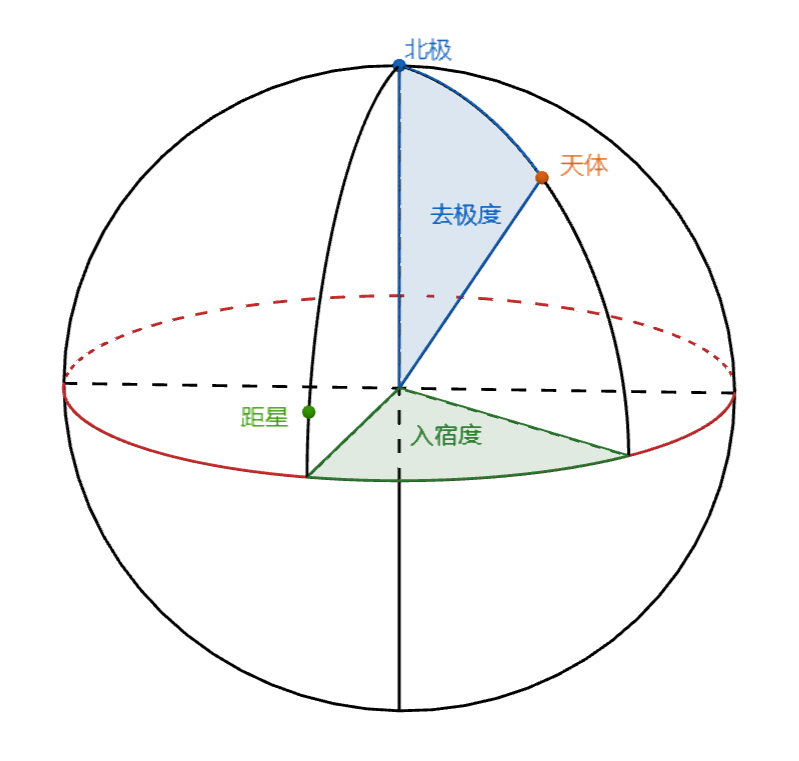
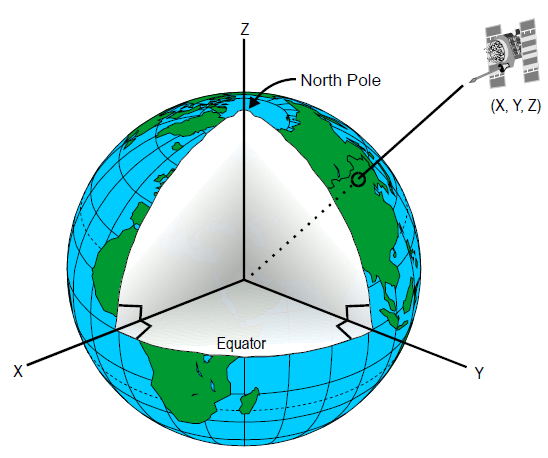
The equatorial coordinate system is fundamental to astronomy and astrodynamics. A star's spherical coordinates are often expressed as a pair, right ascension and declination, without a distance coordinate. The direction of sufficiently distant objects is the same for all observers, making it convenient to specify this direction with the same coordinates for all. In contrast, in the horizontal coordinate system, a star's position differs from observer to observer based on their positions on the Earth's surface, and is continuously changing with the Earth's rotation. Telescopes equipped with equatorial mounts and setting circles employ the equatorial coordinate system to find objects. Setting circles in conjunction with a star chart or ephemeris allow the telescope to be easily pointed at known objects on the celestial sphere. The system also has rectangular variants, all with origin at the centre of Earth, fundamental plane in the plane of Earth's equator, primary direction toward the March equinox, and a right-handed convention. These frames do not rotate with the Earth, remaining always directed toward the equinox, and drifting over time with the motions of precession and nutation. In astronomy, the position of the Sun is often specified in geocentric equatorial rectangular coordinates X, Y, Z, and the positions of planets and other Solar System bodies in ξ, η, ζ. In astrodynamics, the positions of artificial Earth satellites are specified in geocentric equatorial coordinates, also known as geocentric equatorial inertial (GEI), Earth-centred inertial (ECI), and conventional inertial system (CIS).
Did You Know?
- Declination measures angular distance perpendicular to the celestial equator, positive north, negative south.
- Right ascension is usually measured in sidereal hours, minutes, and seconds, with 15° per hour.
- Hour angle is a left-handed system measuring angular distance westward from the observer's meridian.
A Long Line of Pioneers
From Kepler's 1609 publication of his planetary laws to the present day, the mathematical description of orbital motion has been refined over four centuries. Newton's 1687 Principia offered a more general framework, including a method to determine a parabolic orbit from just three observations—a technique Edmund Halley applied to trace the paths of comets, most famously the one that now carries his name. Leonhard Euler formalized Newton's successive approximation into an analytic method in 1744, and Johann Lambert extended the work to elliptical and hyperbolic trajectories between 1761 and 1777. Carl Friedrich Gauss made a landmark contribution in 1801 when his method, using only three pairs of right ascension and declination measurements, allowed the recovery of the dwarf planet Ceres. In the twentieth century, astronomer Samuel Herrick began developing astrodynamics in the 1930s, encouraged by Robert Goddard's conviction that space navigation techniques would one day be essential. By the 1960s, the marriage of numerical methods with powerful computers made crewed lunar missions possible.
Where Orbital Mechanics Meets Celestial Mechanics
Orbital mechanics—sometimes called astrodynamics or space dynamics—brings the tools of ballistics and celestial mechanics to bear on rockets, satellites, and other spacecraft. Its motion calculations rest on Newton's laws of motion and universal gravitation. While the discipline is a core part of space-mission design and control, it sits within the broader field of celestial mechanics, which encompasses the gravitational orbit dynamics of all bodies: star systems, planets, moons, comets, and spacecraft alike. Orbital mechanics zeroes in on spacecraft trajectories—orbital maneuvers, plane changes, and interplanetary transfers—giving mission planners the tools to predict the outcomes of propulsive actions. Until the twentieth century's space era, the distinction between the two fields was minimal; at the time of Sputnik, the discipline was simply called space dynamics. The fundamental techniques, such as solving the Keplerian problem of determining position as a function of time, are shared across both domains, and their histories are almost entirely intertwined.
The Counter-Intuitive Logic of Spaceflight
One of the most striking features of orbital dynamics is how its consequences routinely defy everyday intuition. A satellite in a lower orbit moves faster relative to a planet's surface than one in a higher orbit, because gravitational pull is stronger closer in. If a spacecraft fires its engines at a single point in a circular orbit, it returns to that same point every revolution, but the rest of its path shifts—meaning a single brief thrust cannot transfer it to a different circular orbit. Thrusting opposite to the direction of travel produces an ellipse whose lowest point sits 180 degrees away, with a shorter period; thrusting in the direction of travel creates an ellipse with its highest point 180 degrees away and a longer period. Perhaps most surprisingly, a trailing spacecraft in the same circular orbit cannot simply accelerate to catch up with a leading one. Doing so raises its orbit and slows it relative to the target. A proper rendezvous demands multiple precisely timed engine burns spread across several orbital periods, often taking hours or even days. These rules grow inaccurate when atmospheric drag enters the picture or when two bodies of comparable mass interact, as in binary star systems.
From GPS to General Relativity
The practical reach of orbital mechanics extends far beyond the launch pad. Today, the same orbit-determination techniques that Gauss pioneered for Ceres are embedded in GPS receivers, used to track and catalogue newly discovered minor planets, and essential for operating every type of satellite and space probe, since knowing a spacecraft's future position to high precision is non-negotiable for mission success. While Newton's laws remain the workhorse for most calculations, general relativity provides a more exact theoretical framework. In high-gravity environments—such as orbits passing close to the Sun—or when greater precision is demanded, relativistic corrections become necessary. The field's trajectory from Kepler's empirical laws through Newton's universal gravitation, Euler's analytic formalization, Gauss's orbit recovery, Herrick's astrodynamics, and finally to computer-aided numerical methods in the 1960s illustrates a continuous thread of refinement. What began as pure mathematical astronomy has become the operational backbone of humanity's presence in space.
Gallery
Frequently Asked Questions
What is the Equatorial coordinate system?
It is a geocentric framework used in astronomy and astrodynamics to pin down where objects sit in the sky. Rather than relying on a local horizon, it anchors every measurement to Earth's equator projected outward onto the celestial sphere.
How does the Equatorial coordinate system actually locate an object?
You set the reference plane as the celestial equator, choose the March equinox as the zero-point direction, and apply a right-handed convention to assign angular or rectangular values to the target. This gives you a consistent, Earth-centred address for any star, planet, or spacecraft.
Where is the origin of the Equatorial coordinate system?
The origin sits at the centre of the Earth, making it a purely geocentric reference. Every measurement radiates outward from that single central point rather than from the observer's location on the surface.
What distinguishes the Equatorial coordinate system from other celestial grids?
Its fundamental plane is the projection of Earth's equator onto the celestial sphere, and its primary reference direction points toward the March equinox. Together with a right-handed convention, these choices set it apart from horizon-based or ecliptic-based coordinate schemes.
Why do orbit designers and astronomers rely on the Equatorial coordinate system?
It offers a stable, Earth-centred way to specify the positions of stars, planets, and artificial satellites without being tied to a particular observer's latitude or longitude. That universality makes it the go-to reference across both astronomy and astrodynamics.
More in Orbits And Celestial Mechanics 1-24
Elsewhere in the Orbits And Celestial Mechanics universe
Spotted an error? Know more?
This is a living reference — every entry is fact-audited, and reader corrections feed straight into our audit queue. Suggest an edit · See this site's audit record