
Escape velocity
Minimum speed to escape a body's gravitational pull.

Richard West · CC BY-SA 2.0
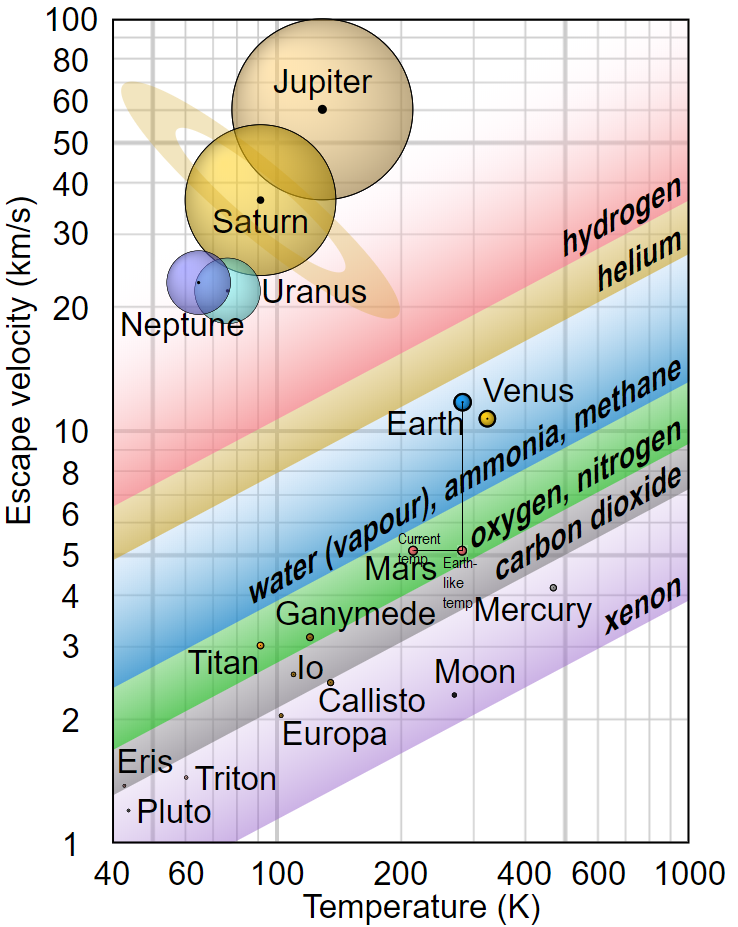
Escape velocity, also called escape speed, is the minimum speed needed for an object to break free from the gravitational influence of a primary body, such as a planet or star, without further propulsion. It is a fundamental concept in celestial mechanics, used to determine whether a spacecraft will remain in orbit or depart into deep space.
- field
- Celestial mechanics
- known_for
- Minimum speed to escape a gravitational field
- formula
- v_e = sqrt(2GM/d)
- key_principle
- Conservation of energy
Lore & Background
Escape velocity is derived from the conservation of energy, assuming only gravitational forces act. For an object of mass m at distance r from a planet of mass M, the kinetic energy plus gravitational potential energy at the start equals zero at infinity, yielding v_e = sqrt(2GM/r). The term is more accurately a speed than a velocity because it is independent of direction. The escape speed varies with distance from the primary body's center. Objects in circular or elliptical orbits always travel slower than escape speed at their current distance, while those on hyperbolic trajectories exceed it. A parabolic trajectory exactly matches escape speed, asymptotically approaching zero speed at infinite distance. Rockets need not achieve escape velocity in a single maneuver; continuous thrust or gravity assists can also achieve escape. Precise calculations must account for small forces like atmospheric drag, radiation pressure, and solar wind, though the minimum energy required remains constant.
Reader's Guide
Escape velocity is a cornerstone of space exploration, enabling engineers to calculate whether a probe will orbit Earth or escape to a heliocentric orbit. It also determines the deceleration needed for gravitational capture at a destination body. The formula v_e = sqrt(2GM/d) shows that escape speed depends only on the primary body's mass and the distance from its center, not on the object's mass for artificial satellites. The concept arises from conservation of energy: an object with specific orbital energy greater than or equal to zero can reach infinity. While the term 'escape velocity' is common, it is a scalar speed. The same result holds in relativistic calculations using the Schwarzschild metric. Understanding escape velocity is essential for mission planning, from launching satellites to interplanetary travel.
Did You Know?
- Escape velocity is independent of direction, making it a speed rather than a velocity.
- An object on a parabolic trajectory always travels exactly the escape speed at its current distance.
- Rockets can attain escape at any non-zero speed using continuous thrust, but the minimum energy required is always the same.
Gallery





Frequently Asked Questions
What is Escape velocity?
Escape velocity is the threshold speed an object must reach to permanently break free from a body's gravitational pull without any additional thrust. In the canon of celestial mechanics, it acts as the dividing line between remaining in orbit and departing into interstellar space.
What is Escape velocity's role in the series?
It serves as the key principle determining whether a spacecraft stays bound in orbit or escapes into deep space, grounded in the conservation of energy. Without reaching this speed, a probe will simply fall back or remain in a closed elliptical path.
What is Escape velocity's signature formula?
Its defining equation is v_e = sqrt(2GM/d), where G is the gravitational constant, M is the mass of the primary body, and d is the distance from its center. This elegant expression shows that escape speed depends only on mass and distance, not on the object's own mass.
Why is Escape velocity important to the broader canon?
It is the fundamental benchmark that separates bound orbital motion from unbound hyperbolic trajectories, making it central to mission planning and interplanetary transfers. Every concept from satellite deployment to solar-system exploration ultimately references this threshold.
More in Orbits And Celestial Mechanics 1-24
Elsewhere in the Orbits And Celestial Mechanics universe
Spotted an error? Know more?
This is a living reference — every entry is fact-audited, and reader corrections feed straight into our audit queue. Suggest an edit · See this site's audit record