
Graveyard orbit
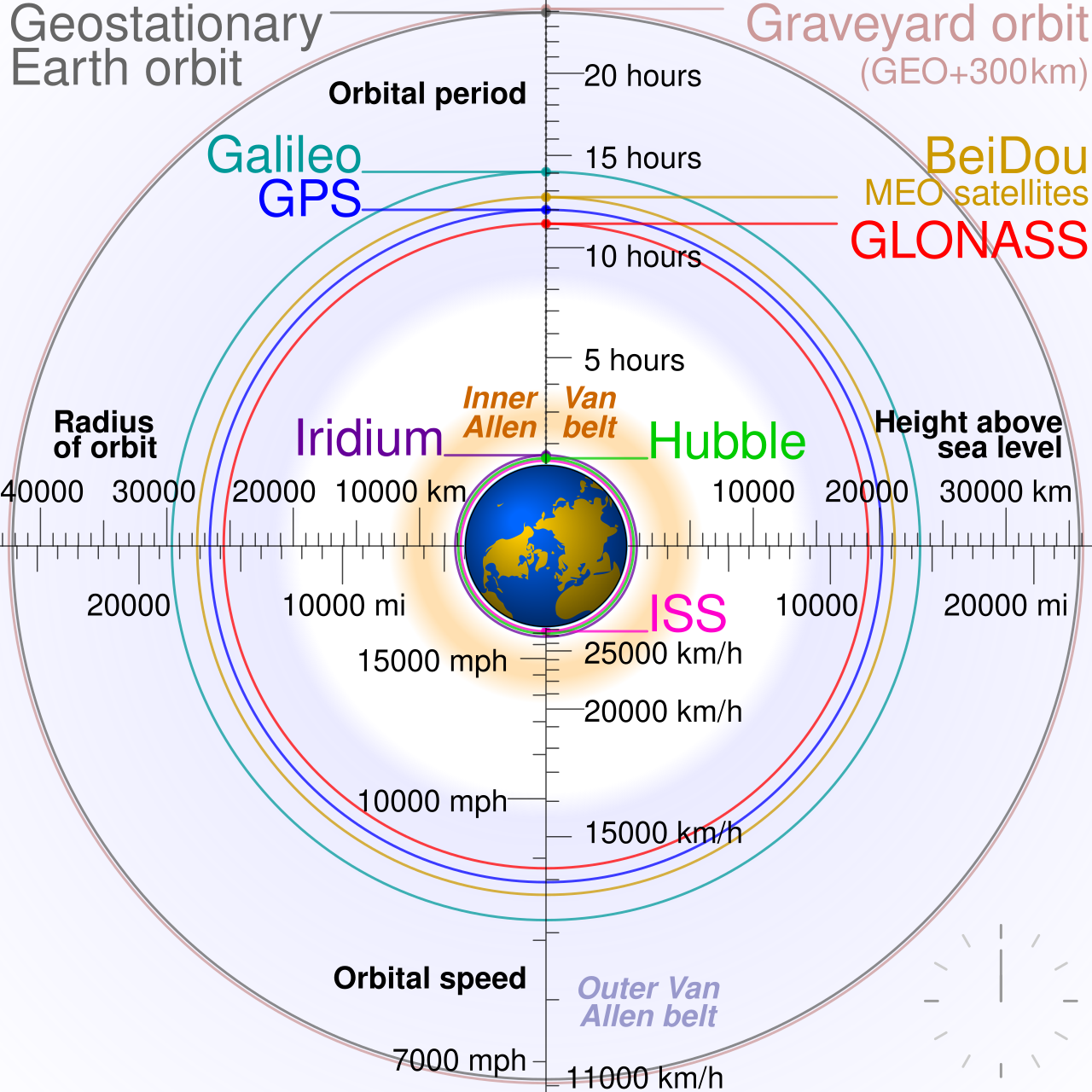
A disposal orbit for end-of-life satellites to reduce debris.

cmglee · CC BY-SA 3.0
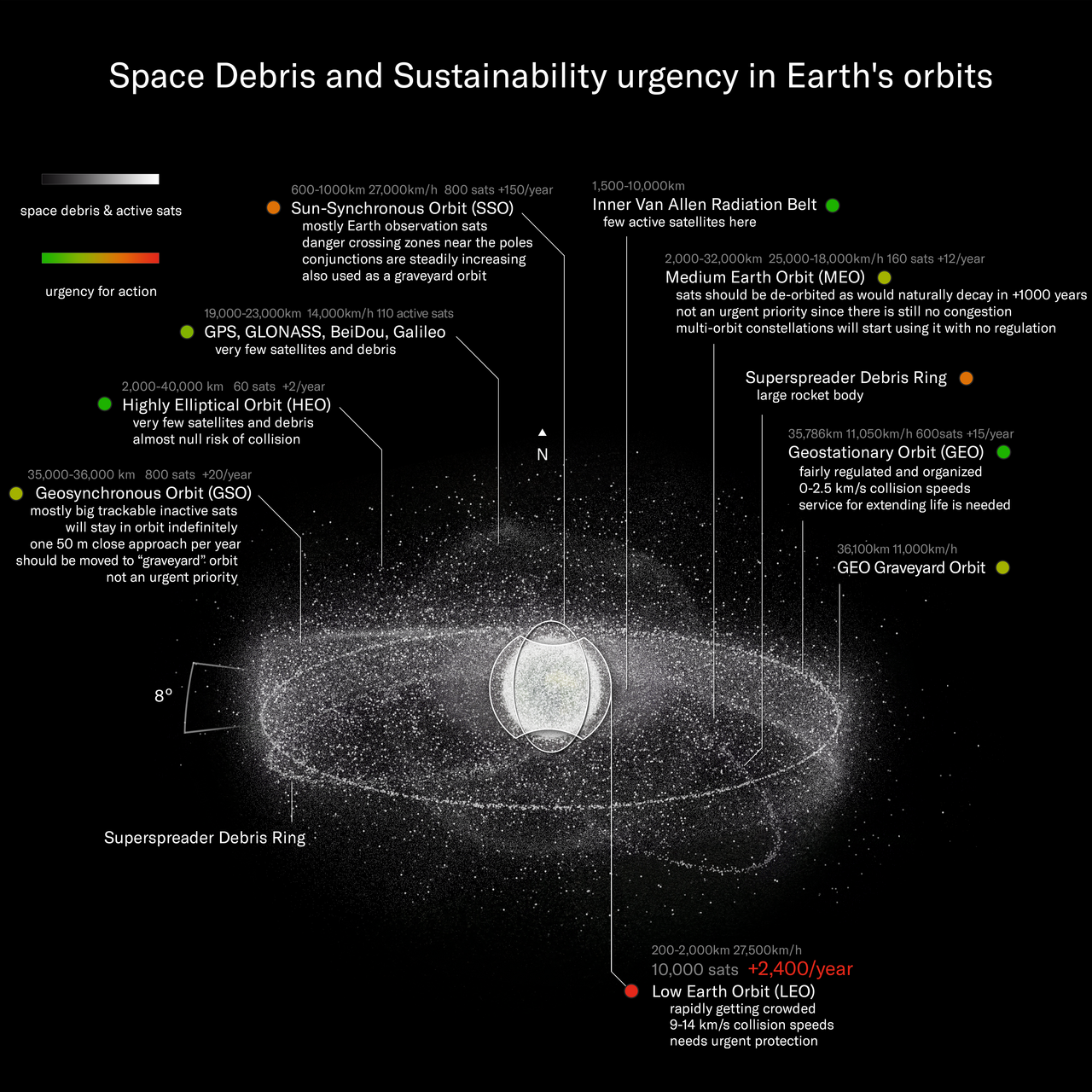
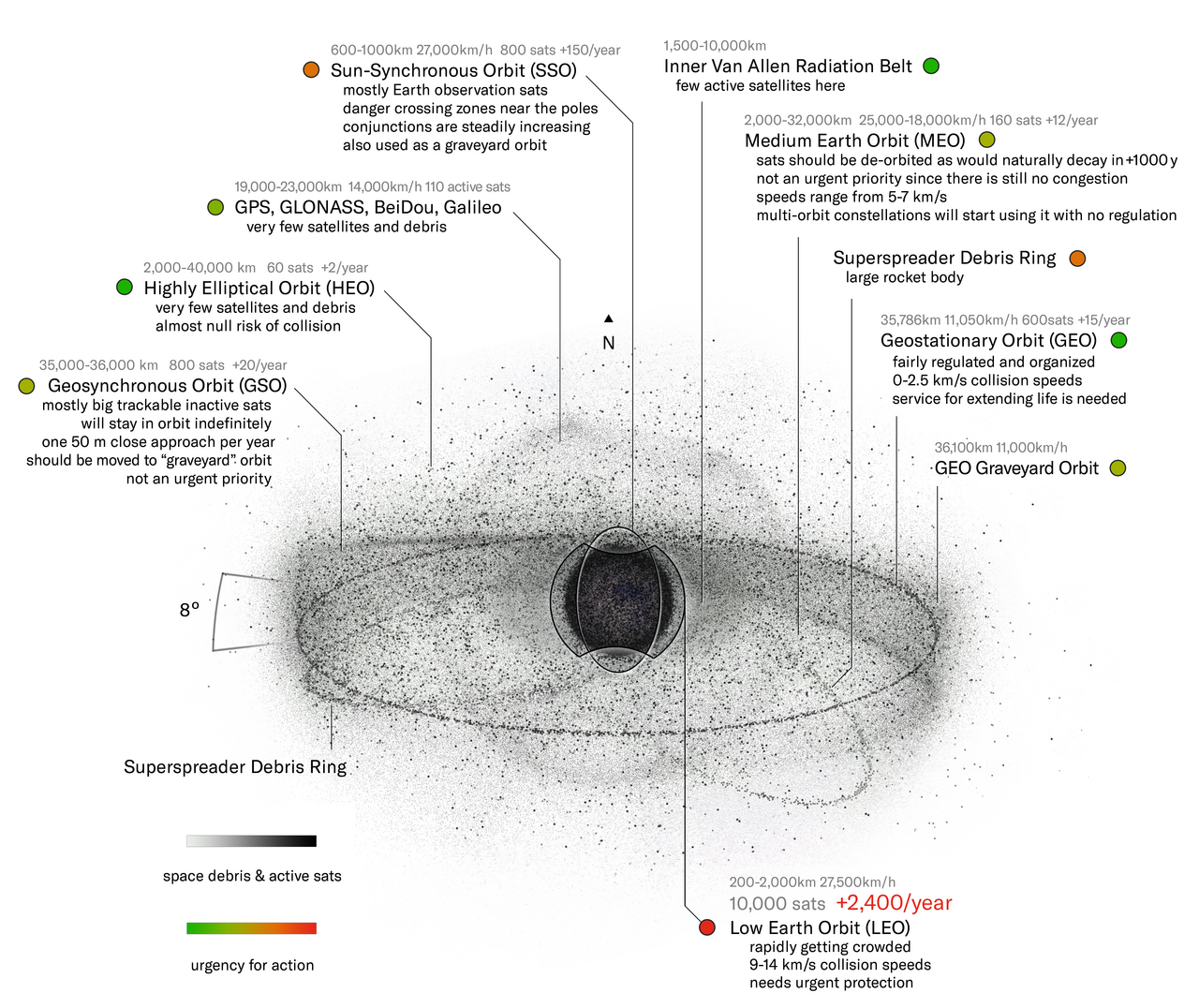
A graveyard orbit, also called a junk orbit or disposal orbit, is an orbit that lies away from common operational orbits. One significant graveyard orbit is a supersynchronous orbit well beyond geosynchronous orbit. Some satellites are moved into such orbits at the end of their operational life to reduce the probability of colliding with operational spacecraft and generating space debris.
- alternative_names
- junk orbit, disposal orbit
- primary_location
- supersynchronous orbit beyond geosynchronous orbit
- typical_delta_v_required
- about 11 metres per second (36 ft/s)
- regulatory_body
- Federal Communications Commission (FCC)
Lore & Background
A graveyard orbit is used when the change in velocity required to perform a de-orbit maneuver is too large. For satellites in geostationary orbit and geosynchronous orbits, the graveyard orbit is a few hundred kilometers beyond the operational orbit. The transfer to a graveyard orbit beyond geostationary orbit requires the same amount of fuel as a satellite needs for about three months of stationkeeping. It also requires a reliable attitude control during the transfer maneuver. While most satellite operators plan to perform such a maneuver at the end of their satellites' operational lives, through 2005 only about one-third succeeded.
Reader's Guide
Graveyard orbits serve as a critical space debris mitigation measure for geosynchronous satellites. By moving a satellite to a supersynchronous orbit a few hundred kilometers above the operational belt, operators reduce the risk of collision with active spacecraft. The Inter-Agency Space Debris Coordination Committee (IADC) provides a formula for the minimum recommended perigee altitude beyond GEO, which includes a 200 km protected zone, 35 km for gravitational perturbations, and a term accounting for solar radiation pressure. While GEO graveyard orbits can have lifetimes of millions of years, large low Earth orbit constellations now use disposal orbits that decay naturally within one year.
Did You Know?
- Through 2005, only about one-third of satellite operators successfully moved their satellites to a graveyard orbit.
- The IADC formula for graveyard orbit altitude includes a term for solar radiation pressure, with coefficient between 1 and 2.
- Uncontrolled objects in near-GEO exhibit a 53-year cycle of orbital inclination, varying ±7.4° at up to 0.8° per year.
Four Centuries of Orbital Mathematics
The mathematical understanding of how objects move under gravity has been built layer by layer over four centuries. Johannes Kepler broke new ground in 1609 by producing the first accurate models of planetary orbits. Nearly eighty years later, Isaac Newton published his Principia in 1687, offering a far more general framework for celestial motion, including a method to determine a parabolic orbit from just three observations. Edmund Halley put that method to work, establishing the orbits of several comets, one of which still carries his name. The analytical foundations were refined further when Leonhard Euler formalized Newton's successive approximation into a proper analytic technique in 1744, and Johann Lambert extended the work to elliptical and hyperbolic paths between 1761 and 1777. Perhaps the most celebrated practical application came in 1801, when Carl Friedrich Gauss used only three pairs of right ascension and declination measurements to recover the orbit of Ceres, the dwarf planet. That single achievement demonstrated that orbit determination could be reduced to a solvable mathematical problem, a principle that would echo through every subsequent era of spaceflight.
Scope: Spacecraft Versus the Cosmos
Orbital mechanics, also called astrodynamics or space dynamics, sits at the intersection of ballistics and celestial mechanics, applying both to rockets, satellites, and other spacecraft. Its central concern is the trajectory of artificial objects in space: orbital maneuvers, plane changes, and interplanetary transfers. Mission planners rely on it to predict exactly where a spacecraft will be after a propulsive burn. The broader discipline of celestial mechanics, by contrast, encompasses the gravitational orbit dynamics of all bodies—star systems, planets, moons, comets—regardless of whether they are natural or engineered. Until the twentieth century brought the first artificial satellites, there was essentially no practical distinction between the two fields; the fundamental techniques, such as solving the Keplerian problem of finding position as a function of time, were identical. The field was originally called space dynamics, a name that reflected its origins in the age of Sputnik. Today, the shared mathematical heritage remains, but the applied focus of orbital mechanics has narrowed to the specific challenges of keeping human-made objects on their intended paths through three-dimensional space.
When Intuition Fails in Orbit
One of the most striking features of orbital mechanics is that its consequences routinely defy everyday intuition. Consider two spacecraft sharing the same circular orbit, with one trailing the other. The trailing craft might seem to simply need a short engine burn to close the gap. In reality, firing its engines forward changes the shape of its orbit, raising its altitude and slowing it relative to the leading craft, so it actually moves farther away. A proper rendezvous and docking therefore requires multiple precisely timed engine firings spread across several orbital periods, often taking hours or even days. Similar counter-intuitions arise from the geometry of thrust: applying force opposite to the direction of motion from a circular orbit produces an ellipse whose lowest point sits 180 degrees from the firing location, shortening the period. Thrust in the direction of motion creates an ellipse with its highest point at the opposite side, lengthening the period. A single brief burn cannot transfer a satellite from one circular orbit to another. These rules, derived from Kepler's laws and Newtonian mechanics, hold under standard assumptions but break down for multi-body systems of comparable mass or when atmospheric drag becomes significant in low Earth orbit.
From Chalkboard to GPS
The bridge between abstract orbital theory and operational spaceflight was forged in the early twentieth century. Astronomer Samuel Herrick began developing the numerical techniques of astrodynamics in the 1930s, and his work was encouraged by rocket scientist Robert Goddard, who foresaw that such navigation methods would become essential. For decades, the mathematics remained largely theoretical, constrained by the limited computing power of the era. The transformation came in the 1960s, when powerful new computers were married to the numerical methods of astrodynamics, providing the computational backbone for sending humans to the Moon and bringing them safely home. The field's reach has only expanded since. Today, orbit determination and prediction underpin the operation of every type of satellite and space probe, because mission success demands knowing a spacecraft's future position with extreme precision. The same mathematical heritage that allowed Gauss to locate Ceres from three observations now powers the GPS receivers in everyday pocket devices and the tracking and cataloguing of newly discovered minor planets. General relativity, a more exact framework than Newton's laws, is invoked when higher accuracy is needed or when orbits pass close to massive bodies such as the Sun.
Gallery
Frequently Asked Questions
What is a graveyard orbit?
A graveyard orbit is a designated parking ring where retired satellites are sent at the end of their mission so they no longer clutter the busy operational bands. It is also commonly called a junk orbit or a disposal orbit.
How much Δv does a satellite need to reach the graveyard orbit?
Only about 11 metres per second (roughly 36 ft/s) of propulsive change is typically required to raise a geostationary satellite into its disposal ring. That small budget is one reason the maneuver is practical even for satellites with limited remaining fuel.
Who sets the rules for deorbiting into a graveyard orbit?
In the United States, the Federal Communications Commission (FCC) is the regulatory body that mandates operators move their satellites to a disposal orbit at end-of-life. The FCC tracks compliance and can enforce penalties when operators fail to perform the maneuver.
More in Orbits And Celestial Mechanics 1-24
Elsewhere in the Orbits And Celestial Mechanics universe
Spotted an error? Know more?
This is a living reference — every entry is fact-audited, and reader corrections feed straight into our audit queue. Suggest an edit · See this site's audit record