
Ecliptic
Apparent path of the Sun on the celestial sphere.

S.fonsi · CC BY-SA 3.0
The ecliptic is the apparent path of the Sun on the celestial sphere, resulting from Earth's orbit around the Sun. It was a central concept in ancient sciences, providing the framework for key measurements in astronomy, astrology, and calendar-making.
- field
- Astronomy
- known_for
- Reference plane for solar system positions and ecliptic coordinate system
- inclination_to_equator
- about 23.4°
- inclination_to_galactic_plane
- 60°
- inclination_to_invariable_plane
- a little more than 1°
Lore & Background
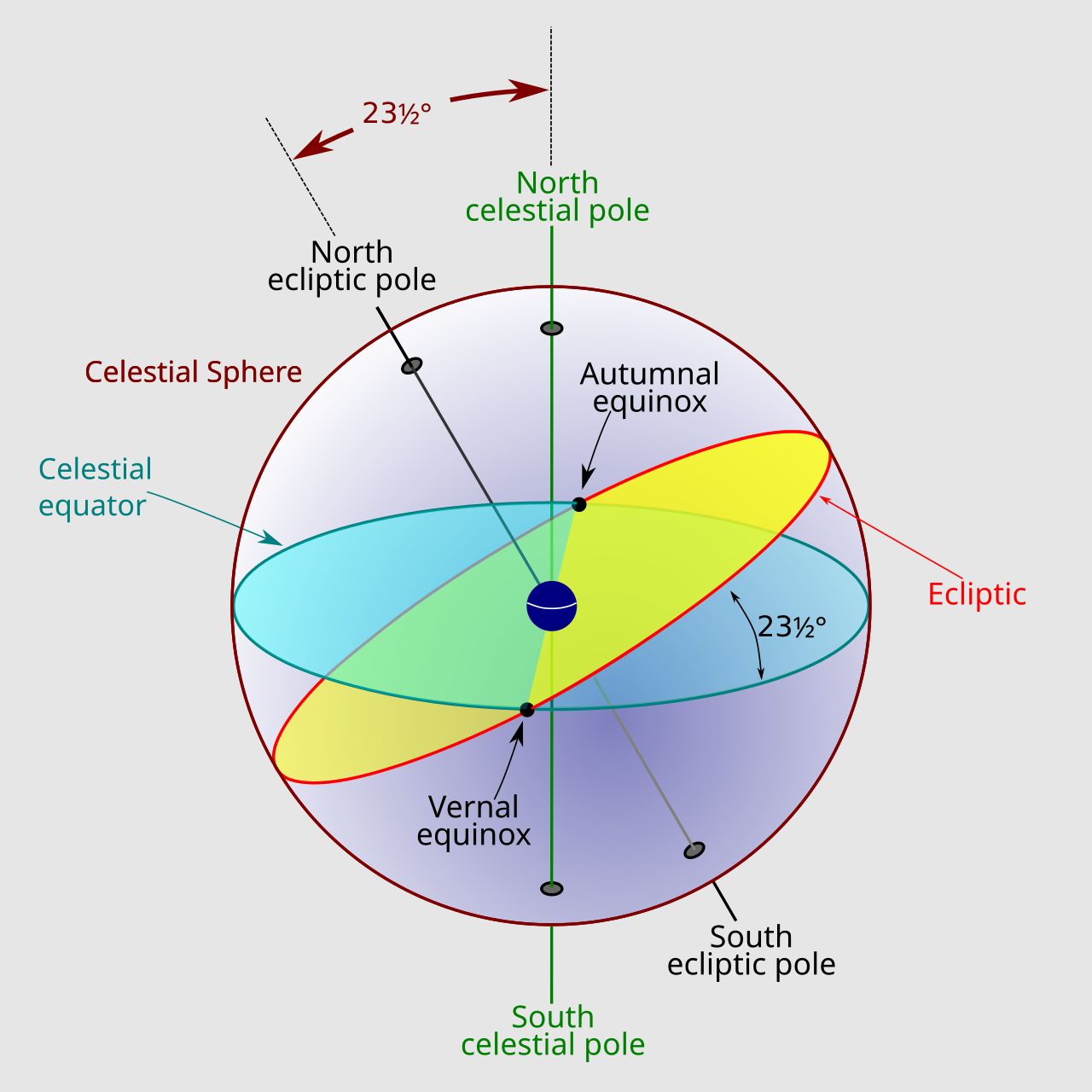
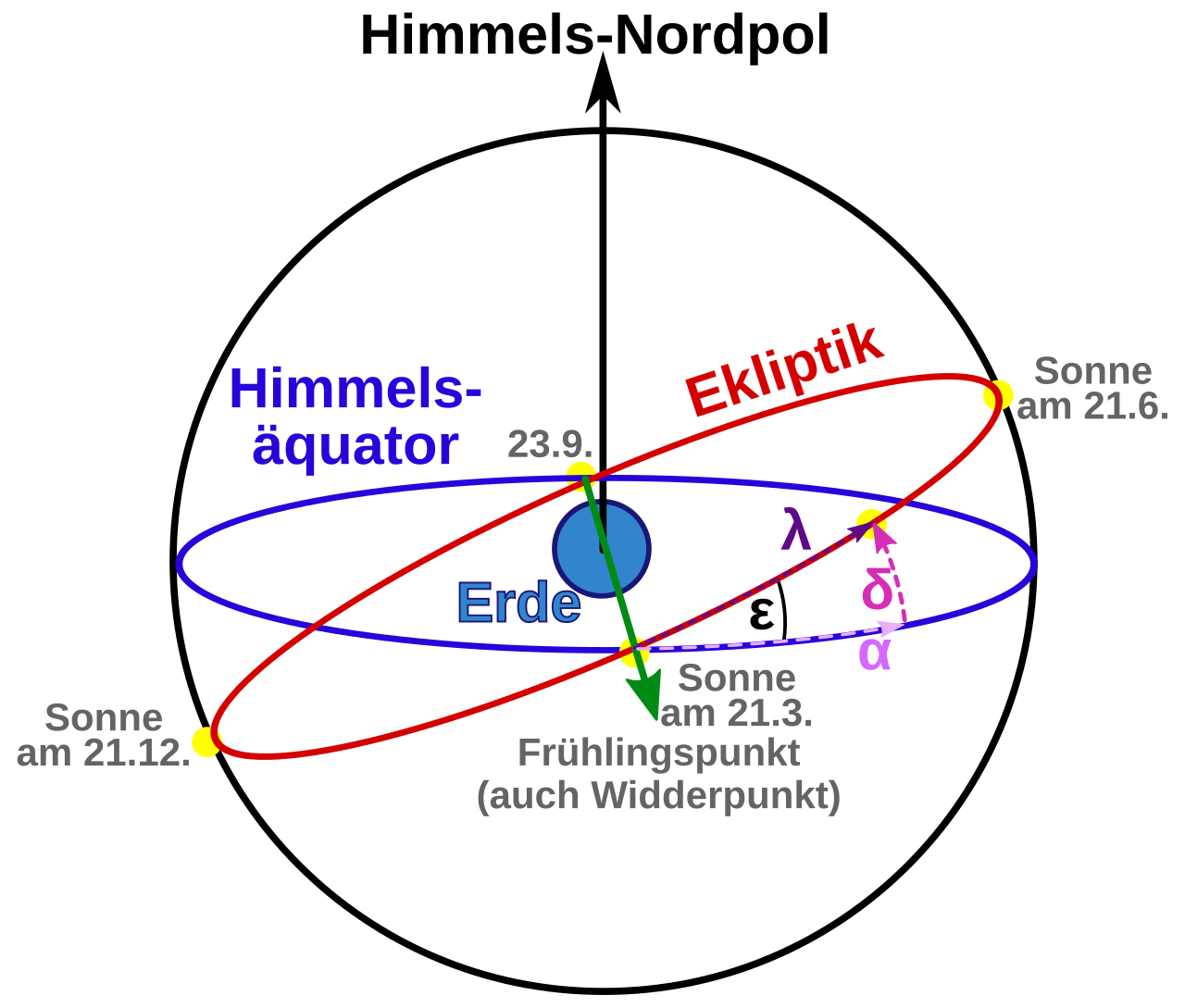
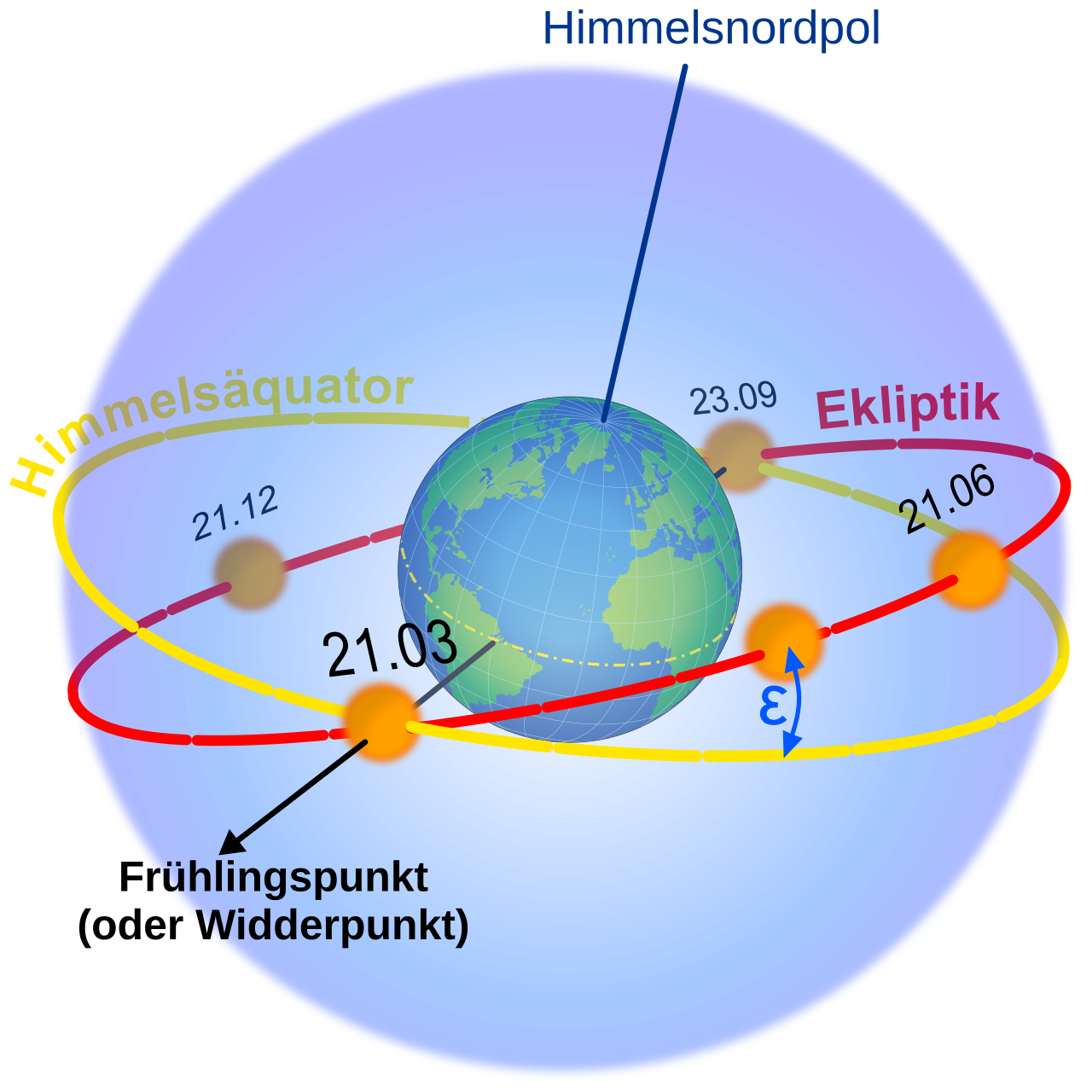
The ecliptic is so named because the ancients noted that eclipses only occur when the Moon is crossing it. The Sun's apparent motion along the ecliptic takes one year to complete a circuit, moving a little less than 1° eastward each day. This daily shift causes any spot on Earth to catch up with the Sun about four minutes later each day, resulting in a 24-hour day rather than the approximately 23-hour 56-minute sidereal day. Because Earth's rotational axis is not perpendicular to its orbital plane, the equatorial plane is inclined to the ecliptic by about 23.4°, known as the obliquity of the ecliptic. The ecliptic crosses the celestial equator at two points called equinoxes: the March equinox (first point of Aries) and the September equinox. The ecliptic forms one of the two fundamental planes for celestial reference, the other being the celestial equator. Spherical coordinates—ecliptic longitude and latitude—are used to specify positions of bodies on the celestial sphere with respect to the ecliptic. Most solar system bodies appear very close to the ecliptic because their orbital planes are near Earth's.
Reader's Guide
The ecliptic serves as a fundamental reference plane for the solar system, used both for precision and convenience. Because most planets orbit near the same plane, they appear along the ecliptic in the sky, making it essential for locating solar system objects. The ecliptic coordinate system, with longitude measured eastward from the March equinox and latitude perpendicular to the ecliptic, is standard for specifying positions of planets and other bodies. Ancient scientists used the ecliptic to calculate Earth's axial tilt by comparing its angle to the equatorial plane. Over geologic time scales, however, the ecliptic moves against fixed reference points. The invariable plane of the solar system is defined by total angular momentum, but because of uncertainty in its exact location, the ecliptic remains the practical reference plane. Modern ephemerides, such as those from the Jet Propulsion Laboratory, provide precise calculations of the obliquity for astronomical almanacs.
Did You Know?
- The ecliptic is named because ancients noted that eclipses only occur when the Moon is crossing it.
- The Moon's orbital plane is inclined only 5.1° to the ecliptic, intersecting it at the lunar nodes.
- The ecliptic is inclined to the galactic plane by 60°.
Ancient Foundations and the Name
The ecliptic earned its name from a simple observational fact: ancient sky-watchers noticed that eclipses only happen when the Moon crosses this particular line in the sky. That connection between the Sun's yearly track and the shadow events of lunar and solar eclipses gave the concept its identity. Far more than a geometric curiosity, the ecliptic served as the backbone for several ancient disciplines. Astronomers used it to chart positions, astrologers mapped the zodiacal constellations along it, and calendar-makers relied on it to structure the year. The Sun's path could be traced against the backdrop of stars, particularly the zodiac constellations, and because the planets' orbital planes sit very close to Earth's, they too appear to travel along this same band. The Moon, whose orbital plane is tilted only about 5.1 degrees from the ecliptic, also lingers near it, intersecting at two points called the lunar nodes. In this way, a single plane unified the motions of nearly every visible body in the night sky.
The Sun's Daily Drift and the Length of a Day
Because Earth completes one orbit around the Sun in roughly 365 days, the Sun's apparent position shifts a little under one degree eastward each day against the fixed stars. This tiny daily increment has a practical consequence: any given location on Earth's surface catches up to the Sun about four minutes later each day than it would if Earth simply rotated in place. The result is the familiar 24-hour solar day rather than the approximately 23-hour-56-minute sidereal day. The motion is not perfectly uniform, though. Earth's orbital speed varies slightly over the year, so the Sun's apparent pace along the ecliptic speeds up and slows down, contributing to what is called the equation of time. The Sun spends roughly 185 days north of the celestial equator and about 180 days south of it. Additionally, because Earth orbits the Earth-Moon barycenter rather than the Sun directly, the Sun's path wobbles gently with a monthly period, and further perturbations from other planets add a more complex, long-term drift to the barycenter's position.
A Plane Born from a Disk
The reason so many Solar System bodies cluster near the ecliptic is a story written in the system's formation. The planets are believed to have condensed from a protoplanetary disk of dust and gas that orbited the young Sun close to a single plane. The invariable plane of the Solar System, defined by the total angular momentum of every orbiting and rotating body, captures that primordial alignment. More than sixty percent of that angular momentum comes from Jupiter's orbit alone. Earth's orbit, and therefore the ecliptic, sits just over one degree from the invariable plane; Jupiter is within half a degree, while Mercury, the most inclined major planet, deviates by about six degrees. Despite the invariable plane's theoretical elegance, its exact position is hard to pin down because it demands precise knowledge of every object in the system. The ecliptic, by contrast, is cleanly defined by the Sun's observable annual motion, making it the practical reference plane for Solar System coordinates. Its one drawback is that, over geologic timescales, it will slowly shift against the distant stars. The ecliptic also tilts sixty degrees relative to the galactic plane.
Tilt, Equinoxes, and a Coordinate Grid
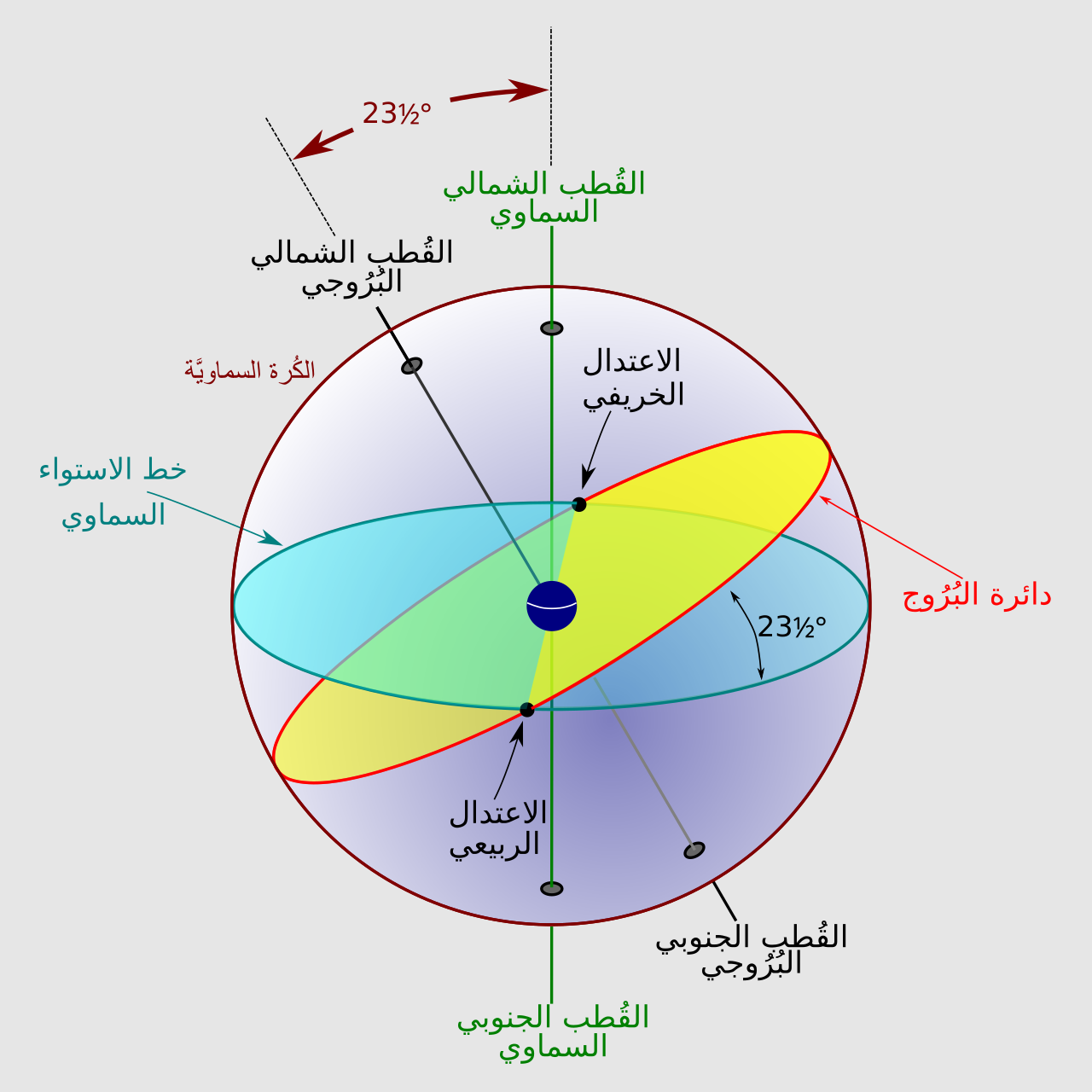
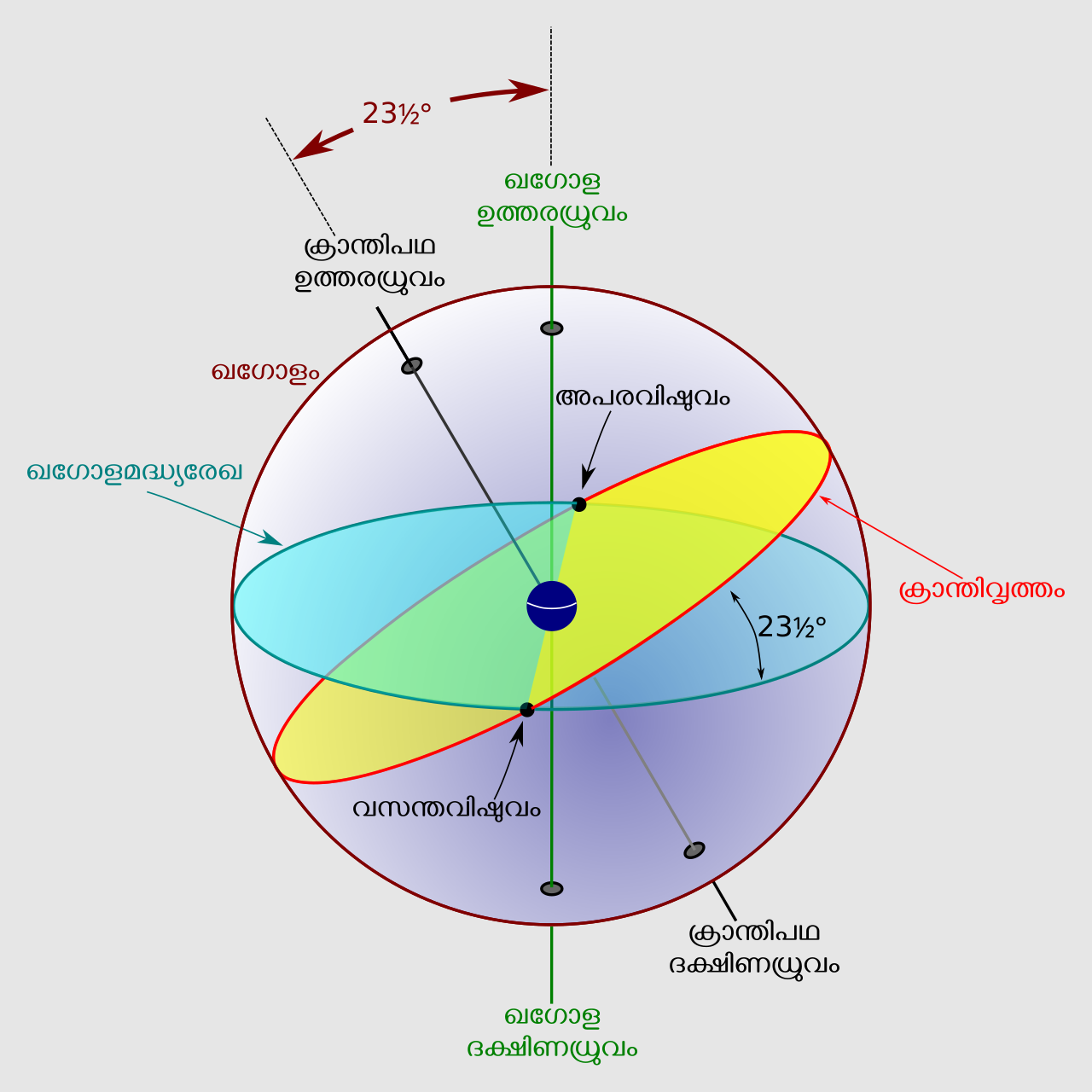
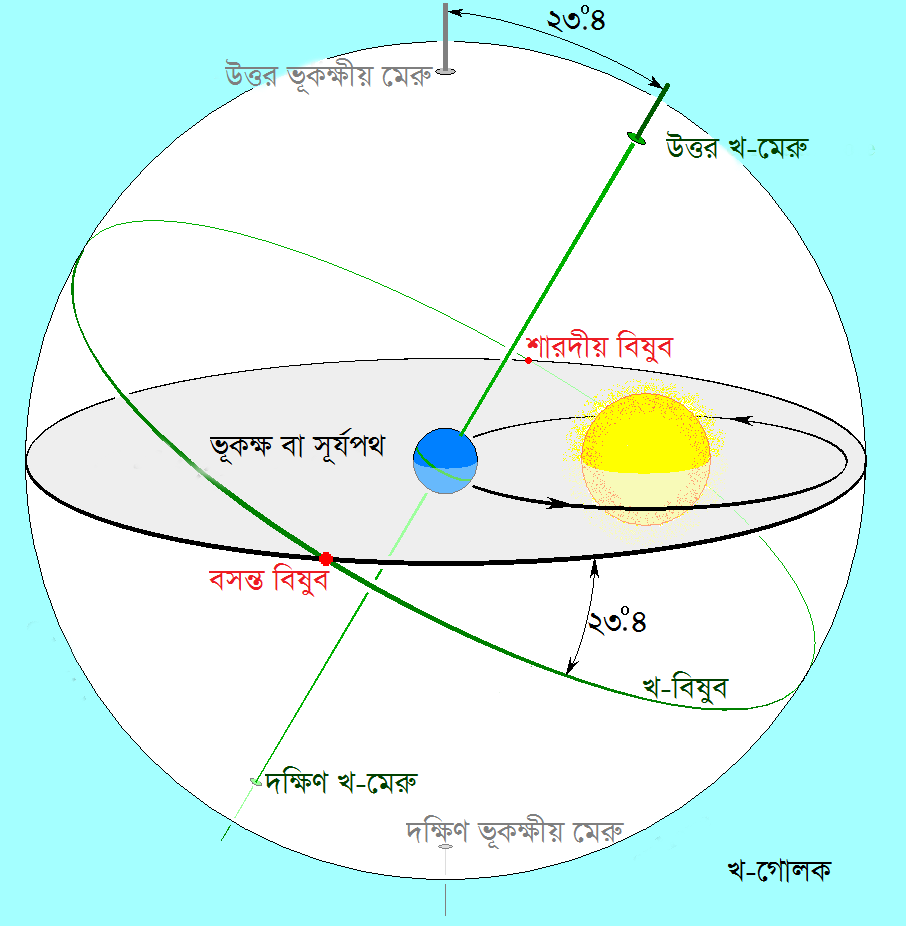
Earth's spin axis is not perpendicular to its orbital plane, so the equatorial plane and the ecliptic plane are inclined to each other by about 23.4 degrees, an angle called the obliquity of the ecliptic. Where the projected celestial equator crosses the ecliptic, two special points emerge: the March equinox, where the Sun moves from south to north (also called the first point of Aries or the ascending node), and the September equinox, the descending node. The ecliptic serves as one of the two fundamental reference planes for locating objects on the celestial sphere, the other being the celestial equator. Notably, the ecliptic is closer to being fixed against the background stars; its slow drift due to planetary precession is roughly one-hundredth the rate of the celestial equator's motion. Positions are specified with ecliptic longitude, measured eastward from zero to 360 degrees starting at the March equinox, and ecliptic latitude, measured from zero at the ecliptic up to plus 90 or minus 90 degrees at the ecliptic poles. A distance parameter completes the spherical position, with astronomical units used within the Solar System and Earth radii or kilometers for nearby objects.
Gallery
Frequently Asked Questions
What is the Ecliptic?
The Ecliptic is the apparent yearly track the Sun traces across the celestial sphere, a direct consequence of Earth's orbital motion around the Sun. It serves as the foundational reference plane for locating objects within the solar system.
Why is the Ecliptic important in celestial mechanics?
It provides the natural reference plane from which the ecliptic coordinate system is built, making it the standard framework for expressing the positions of planets, asteroids, and other solar-system bodies. Ancient astronomers, astrologers, and calendar-makers all relied on this plane to organize their observations.
What is the Ecliptic's tilt relative to Earth's equator?
The Ecliptic is inclined at roughly 23.4 degrees to the celestial equator, which is the geometric reason behind the seasons and the variation in solar altitude throughout the year.
How does the Ecliptic relate to the galactic plane?
The Ecliptic sits at an angle of about 60 degrees to the Milky Way's galactic plane, meaning the Sun's apparent path across the sky is almost perpendicular to the disk of our galaxy as seen from Earth.
What is the Ecliptic's angle to the invariable plane?
The Ecliptic is inclined only a little more than one degree to the solar system's invariable plane, reflecting the fact that most planetary orbital planes cluster very close to the Sun's equatorial plane.
More in Orbits And Celestial Mechanics 1-24
Elsewhere in the Orbits And Celestial Mechanics universe
Spotted an error? Know more?
This is a living reference — every entry is fact-audited, and reader corrections feed straight into our audit queue. Suggest an edit · See this site's audit record